From Barren Seafloor to Living Forest: The Long Road Back for California's Kelp
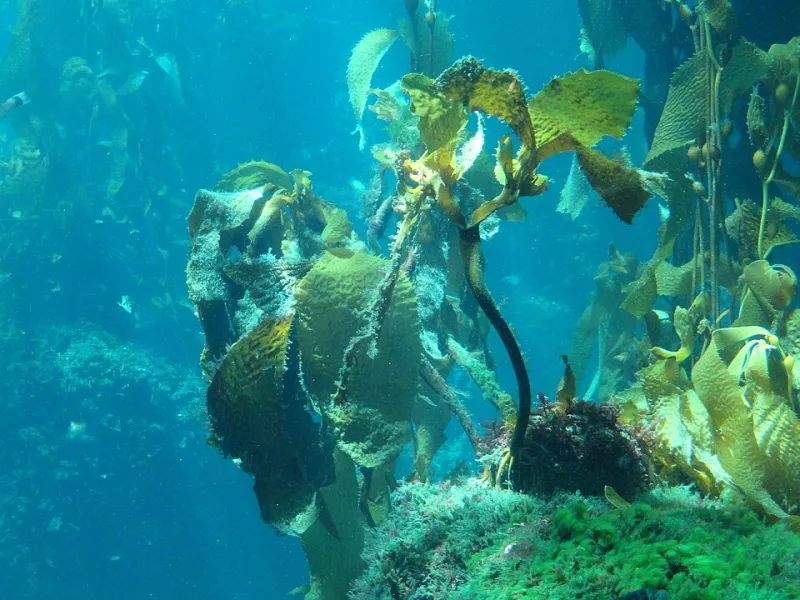
Photo: Daderot, CC0, via Wikimedia Commons
There is a particular kind of silence underwater that experienced divers describe when they first encounter an urchin barren. Where a kelp forest once stood—its amber stipes rising thirty feet or more toward the surface, its canopy filtering light into cathedral patterns across the seafloor—there is now an open, featureless plain of purple sea urchins, densely packed and grazing on whatever organic matter drifts within reach. For marine biologists who have studied California's nearshore ecosystems for decades, that silence carries the weight of ecological loss measured not in individual organisms but in entire trophic structures.
The collapse of bull kelp (Nereocystis luetkeana) forests along the Northern California coast has been among the most extensively documented marine ecosystem failures in recent US history. Between 2014 and 2019, surveys conducted by the California Department of Fish and Wildlife recorded a reduction in bull kelp canopy extent of more than 95 percent across large sections of the Sonoma and Mendocino county coastlines. The causes were not singular. They were sequential, compounding, and in several respects, still unfolding.
A Cascade of Pressures
The story of California's kelp collapse is inseparable from the broader story of climate-driven ocean change. The marine heat wave that gripped the northeastern Pacific from 2014 to 2016—a phenomenon researchers nicknamed "The Blob"—elevated sea surface temperatures across a vast region, stressing bull kelp at the precise moment that a second crisis was developing beneath the surface.
Sea star wasting disease, caused by a densovirus that spread with devastating speed beginning in 2013, decimated populations of sunflower sea stars (Pycnopodia helianthoides) along the entire Pacific Coast. The sunflower star is the primary predator of purple sea urchins (Strongylocentrotus purpuratus) in this ecosystem. Its near-total disappearance from California waters removed the principal biological mechanism that had historically kept urchin populations in check.
Without predation pressure, urchin populations exploded. In years prior, urchins had coexisted with kelp forests in a dynamic but stable relationship, grazing on drift kelp and remaining largely passive when food was plentiful. As their numbers surged into densities that overwhelmed the available drift food supply, urchins transitioned into an active grazing mode, moving across the substrate and consuming kelp holdfasts directly. Once a kelp forest is grazed to bare rock, recovery becomes self-limiting: juvenile kelp sporophytes require hard substrate to settle, but urchins in barren conditions consume recruits almost immediately upon settlement.
Warm water, disease, and population dynamics had converged into a trap.
Restoration Strategies and the Debate They Carry
The conservation community's response to the kelp collapse has been energetic, if not always unified in direction. Several distinct restoration approaches have emerged, each carrying its own assumptions about how much human intervention is appropriate and how quickly results can realistically be expected.
Urchin removal programs represent the most direct form of active management. Volunteer dive teams and commercial harvesters have conducted targeted culling operations along sections of the Mendocino and Sonoma coastlines, physically clearing urchins from designated restoration zones to allow kelp recruitment to occur. Early results from some of these sites have been encouraging: where urchin densities have been reduced sufficiently, juvenile bull kelp has reestablished in areas that were barren for years. Organizations including the Greater Farallones Association and the Reef Check Foundation have documented measurable canopy recovery in treated plots.
However, the scale challenge is formidable. The barren zones extend across hundreds of miles of coastline, and the logistical and financial resources required to manually clear urchins across that expanse are well beyond what current restoration budgets can sustain. Critics of culling-focused strategies argue that without addressing the underlying conditions that enabled the collapse—warm water anomalies, the absence of sunflower stars—any cleared area is vulnerable to recolonization by urchins migrating in from adjacent barrens.
This is where sunflower sea star recovery enters the conversation as a potentially transformative, if long-horizon, intervention. The Species Preservation Laboratory at Friday Harbor and several partner institutions have made progress in captive breeding of sunflower stars, a species that proved extraordinarily difficult to maintain in aquarium conditions. Researchers at The Nature Conservancy have developed more refined protocols that have improved survival rates in captive populations. Whether reintroduction at ecologically meaningful densities is achievable within a timeframe relevant to kelp recovery remains an open scientific question, and one that generates genuine disagreement among restoration ecologists.
Nature-Based Solutions: Patience or Passivity?
A third perspective in the restoration debate emphasizes the regenerative capacity of coastal ecosystems when given adequate protection from additional stressors. Proponents of this view point to historical evidence suggesting that kelp forests have recovered from previous disturbance events—including past warm water anomalies and localized urchin outbreaks—through natural processes, provided that ocean conditions returned to more favorable parameters.
The argument holds particular weight in discussions of marine protected areas. California's network of MPAs, established under the Marine Life Protection Act, has in some locations produced measurable increases in fish biomass and species diversity. In theory, recovering populations of kelp-associated fish species—including sheephead and cabezon, both of which consume urchins at various life stages—could contribute to restoring some degree of natural urchin regulation over time.
Skeptics counter that the current ecological context differs fundamentally from historical disturbance cycles. Climate projections for the California Current system anticipate continued warming, more frequent marine heat wave events, and altered upwelling dynamics that affect the nutrient conditions kelp requires to thrive. Waiting for natural recovery under conditions that may not return to historical norms, they argue, is not patience—it is inaction dressed in ecological language.
What Recovery Looks Like, and Who Decides
The communities with the most immediate stake in this question are not always the loudest voices in the scientific literature. Commercial urchin harvesters along the Mendocino coast, whose livelihoods depended on the red urchin (Mesocentrotus franciscanus) fishery that collapsed alongside the kelp, have watched their industry diminish as purple urchins of negligible market value overwhelmed the ecosystem. Some harvesters have become active participants in restoration efforts, applying their knowledge of local underwater terrain to urchin removal operations. Their engagement represents a model of community-integrated conservation that researchers and managers have increasingly sought to formalize.
Abalone populations—particularly the northern abalone (Haliotis kamtschatkana)—have also suffered severely in the absence of kelp, compounding the economic and cultural significance of the ecosystem's decline for coastal communities.
For the marine scientists engaged in this work, the intellectual challenge is matched by the urgency of the practical stakes. Kelp forests are among the most productive marine habitats on the planet, supporting extraordinary biodiversity, sequestering carbon, and buffering shorelines against wave energy. Their recovery along the California coast is not a matter of restoring a scenic backdrop—it is a question of whether a foundational ecosystem can be rebuilt in a period of accelerating environmental change.
The answer, most researchers agree, will require both scientific humility about what is not yet known and the institutional commitment to act on what is. The kelp forest debate is, in that sense, a microcosm of the larger challenge facing marine conservation in the twenty-first century: how to intervene wisely in systems whose complexity exceeds our current capacity to fully model, while the window for effective action continues to narrow.