Counting the Invisible: Why US Microplastic Research Is Failing Coastal Fisheries
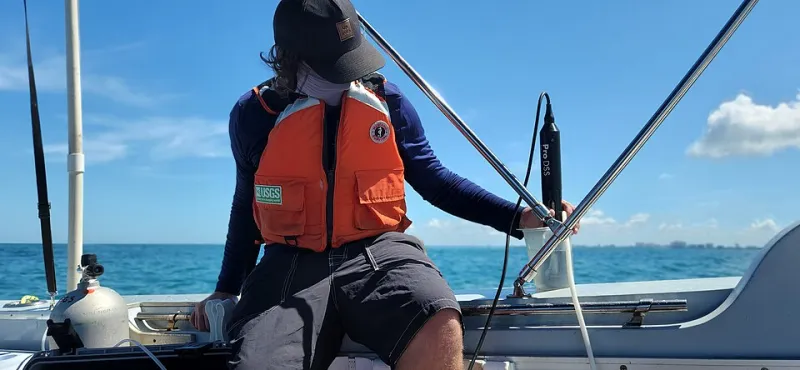
Photo: Meaghan Emory, USGS. St. Petersburg Coastal and Marine Science Center, Public domain, via Wikimedia Commons
Walk into any marine biology laboratory along the US coastline—from the trawler-busy waters off Gloucester, Massachusetts, to the estuarine flats of Louisiana's Gulf Coast—and you will find researchers wrestling with the same frustrating paradox. Microplastics are everywhere. The science confirming their presence in ocean ecosystems is now robust enough to be considered settled. Yet when scientists attempt to quantify just how much contamination exists, and what it means for commercially important fish populations, the numbers fall apart.
Studies conducted in the Gulf of Mexico, the Pacific Northwest, and the mid-Atlantic region routinely produce contamination figures that differ by orders of magnitude, even when examining species with overlapping habitats. For a research community that prides itself on precision, this level of divergence is not merely inconvenient—it is scientifically untenable.
A Patchwork of Methods, A Patchwork of Results
The core of the problem is methodological fragmentation. There is currently no federally mandated standard protocol for collecting, processing, or reporting microplastic contamination data in US fisheries research. As a result, individual laboratories have developed their own procedures, often shaped by available equipment, funding constraints, and the specific research questions they were originally designed to answer.
Some researchers filter water samples through 300-micron mesh screens; others use 63-micron screens. The difference is not trivial. A finer mesh captures a substantially broader spectrum of particle sizes, and because smaller microplastics are far more abundant in ocean water than larger fragments, the resulting contamination counts can diverge by a factor of ten or more. When a study from Puget Sound and a study from Chesapeake Bay use different filtration thresholds and then publish results in comparable units, any direct comparison becomes scientifically meaningless.
Tissue analysis presents its own complications. The chemical digestion methods used to isolate microplastics from fish gut contents—hydrogen peroxide, potassium hydroxide, enzymatic digestion—each degrade certain polymer types at different rates. A laboratory in San Diego relying on one digestion protocol may systematically undercount polyester fibers while accurately capturing polyethylene fragments, while a laboratory in Seattle using a different method may produce the opposite bias. Neither team is being careless; they are simply working within different inherited frameworks.
Voices from the Field
The frustration among working scientists is palpable. Dr. Sandra Okafor, a marine ecotoxicologist whose research focuses on forage fish in the California Current system, describes the situation plainly: the field has produced an enormous volume of data, but assembling that data into a coherent national picture is like trying to read a book where every chapter is written in a different language.
Her concern extends beyond academic inconvenience. Forage fish such as Pacific sardines and northern anchovies form the nutritional backbone of ecosystems supporting commercially harvested species like salmon and albacore tuna. If contamination loads in forage fish populations are being systematically undercounted or inconsistently measured, fisheries managers are making stock assessment decisions on flawed information.
In the Gulf of Mexico, researchers examining red snapper and Gulf menhaden have encountered similar challenges. One recurring issue is the absence of standardized blank controls during field sampling. Airborne microplastic fiber contamination—from researchers' clothing, laboratory air, and collection equipment—can introduce significant false positives into tissue samples if rigorous contamination controls are not applied. Studies that account for this variable and those that do not produce incomparable results, yet both may appear in peer-reviewed literature without sufficient disclosure of their procedural differences.
The Regulatory Vacuum
The National Oceanic and Atmospheric Administration has acknowledged the standardization problem in general terms, and several interagency working groups have discussed the need for unified monitoring frameworks. However, progress toward a binding national protocol has been slow, hampered by jurisdictional complexity, competing research priorities, and the practical difficulty of retrofitting existing long-term monitoring programs to new methodological standards.
The Environmental Protection Agency's ongoing efforts to classify microplastics as a contaminant of concern under the Safe Drinking Water Act have renewed attention to the issue in freshwater contexts, but marine fisheries monitoring has remained largely outside that regulatory conversation. Critics argue that the absence of a federal mandate has allowed the methodological patchwork to persist far longer than the science warrants.
Some researchers point to the European Union's MSFD Technical Group on Marine Litter as a model worth adapting for the US context. That framework, while imperfect, has produced a degree of cross-national comparability in European marine monitoring data that US researchers currently lack even within their own country.
What Standardization Would Actually Require
Developing a unified protocol is not simply a matter of choosing one method over another. It requires the research community to make explicit, evidence-based decisions about particle size thresholds, polymer identification techniques—Fourier-transform infrared spectroscopy and Raman spectroscopy being the two dominant analytical approaches—sample storage conditions, and reporting units. Each of these decisions carries trade-offs, and reaching consensus will require sustained coordination among federal agencies, academic institutions, and state-level monitoring programs.
A tiered protocol system has been proposed in several recent commentaries: a minimum baseline standard accessible to programs with limited resources, and a more comprehensive advanced standard for well-funded research initiatives. This approach would preserve flexibility while ensuring that baseline comparability is maintained across the national data landscape.
Funding is the other critical variable. Many of the laboratories producing microplastic research in the US operate on constrained budgets, and upgrading analytical equipment or retraining staff to conform to new protocols carries real costs. Any standardization initiative that does not address the resource dimension risks creating a de facto two-tier system in which well-funded coastal universities produce high-quality comparable data while smaller state and tribal monitoring programs fall further behind.
The Stakes for Fisheries Management
US commercial fisheries represent a multi-billion-dollar industry and a food security resource for millions of Americans. The communities most exposed to any deterioration in fish population health—fishing towns along the Gulf Coast, Alaska Native communities dependent on subsistence harvesting, Pacific Northwest commercial fishing families—are also among those least positioned to absorb the economic consequences of management decisions made on inadequate data.
Microplastics are now documented in virtually every marine habitat studied, from deep-sea sediments to Arctic sea ice. Their presence in the digestive tracts of commercially harvested fish is no longer in scientific dispute. What remains unresolved—and what the current methodological fragmentation prevents from being resolved—is the quantitative question: how much, where, in which species, and at what rates of accumulation?
Until the US marine science community answers that question with data that can be meaningfully compared across regions and over time, fisheries managers will continue operating in an information environment that is, at best, incomplete. The invisible particles accumulating in US coastal waters deserve a research infrastructure capable of counting them accurately. Building that infrastructure is not beyond reach—but it will require the kind of coordinated institutional commitment that has so far proven elusive.