Volunteers on the Water: How Everyday Mariners Are Reshaping What We Know About America's Oceans
Photo: Jens Bemme, CC BY 4.0, via Wikimedia Commons
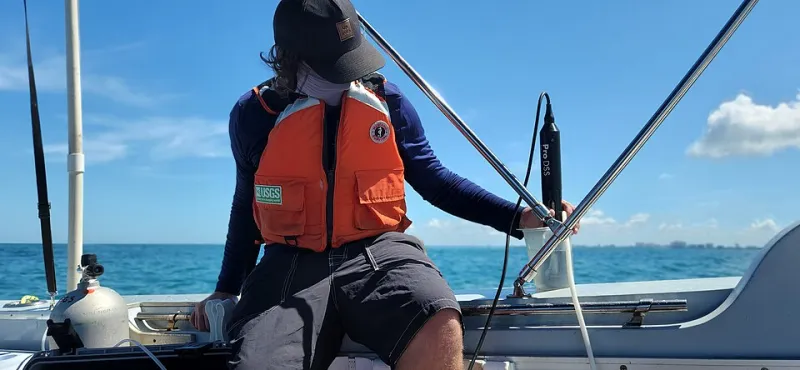
On a Tuesday morning in early June, a retired schoolteacher named Carol Brandt motors her 22-foot Boston Whaler out of Beaufort Inlet, North Carolina, and lowers a Secchi disk into the gray-green water of Onslow Bay. She records the depth at which the disk disappears from view, notes the GPS coordinates on a waterproof logsheet, and photographs the water surface with her phone before heading toward her usual fishing spot. This data point—one of several hundred she will collect over the course of the year—will eventually find its way into a database maintained by the Southeast Coastal Ocean Observing Regional Association, where it joins observations from dozens of other volunteers monitoring water clarity along the Carolina coast.
Brandt is one of an estimated 300,000 Americans who now participate in some form of citizen science program tied to ocean and coastal monitoring. They range from competitive offshore anglers equipped with sophisticated sonar systems to kayakers paddling estuary transects for local land trusts. What they share is access to water that federally funded research vessels and monitoring buoys simply cannot cover continuously, affordably, or at fine enough spatial resolution to capture the variability that increasingly matters in a changing ocean.
The Coverage Problem No Agency Can Fully Solve
The United States maintains one of the most extensive ocean observing systems in the world. The Integrated Ocean Observing System (IOOS), a NOAA-coordinated network of buoys, gliders, high-frequency radar installations, and satellite sensors, generates an enormous volume of real-time data across all US coastal regions. Yet even IOOS program managers acknowledge that significant coverage gaps persist—particularly in shallow nearshore zones, estuaries, and remote coastal areas where fixed infrastructure is expensive to deploy and maintain.
Federal budget constraints have not helped. Between 2010 and 2023, the number of active NOAA research vessels declined, and several regional monitoring programs were reduced in scope. The result is an observational network that is robust in some areas and surprisingly thin in others. Harmful algal bloom events, hypoxic dead zones, and rapid temperature fluctuations in nearshore habitats can develop and dissipate between scheduled monitoring cruises, leaving researchers with incomplete records of events that have significant consequences for fisheries and coastal ecosystems.
This is the gap that citizen science programs are increasingly being asked to fill—and in some cases, are genuinely filling.
Programs That Are Working
The CoastWatch Volunteers program operated by the National Estuarine Research Reserve System has trained more than 4,000 volunteers across 30 reserve sites to conduct standardized monitoring of water quality, wildlife presence, and habitat condition. Longitudinal analysis of CoastWatch data from reserves in Virginia and Oregon has demonstrated that volunteer-collected water temperature and salinity records are statistically comparable to instrument-based measurements when volunteers follow standardized protocols and use calibrated equipment.
In the Pacific Northwest, the Puget Sound Citizen Monitoring Program has enlisted recreational boaters and ferry passengers to report observations of marine mammal sightings, surface debris, and unusual water discoloration through a mobile application developed in partnership with the University of Washington's School of Oceanography. Over five years of operation, the program has generated more than 18,000 georeferenced observations, several of which provided the earliest documented records of harmful algal bloom events in areas not covered by routine monitoring.
Perhaps the most technically ambitious example is the Reef Environmental Education Foundation (REEF) fish survey program, which trains recreational divers to conduct standardized fish counts on coral and rocky reef systems across the Gulf of Mexico, Caribbean, and Pacific coast. REEF's database now contains more than 250,000 surveys, and peer-reviewed analyses of the data have been published in journals including Marine Ecology Progress Series and Biological Conservation. The program is widely cited among marine biologists as a model for what rigorous volunteer training and data quality control can achieve.
The Reliability Question
Not every researcher, however, is persuaded that citizen-collected data belongs in the same analytical category as professionally gathered observations. The concerns are not trivial. Volunteer turnover creates inconsistencies in methodology. Equipment calibration varies. Observer skill and attentiveness differ in ways that are difficult to quantify or correct for statistically. And the spatial distribution of volunteers tends to reflect where people recreate rather than where scientific sampling is most needed—a bias that can systematically skew datasets in ways that are not always apparent until significant resources have been invested in analysis.
Dr. James Okafor, a biological oceanographer at the University of Miami's Rosenstiel School of Marine, Atmospheric, and Earth Science, has published work examining the statistical properties of citizen-collected plankton data from Florida coastal waters. His findings were mixed. "In areas with high volunteer density and strong program coordination, the data held up reasonably well against independent verification," he noted in a 2022 paper. "In lower-density areas, the noise-to-signal ratio was high enough to limit usefulness for trend detection over short time scales."
This honest assessment reflects a broader tension within the citizen science community: enthusiasm for the participatory model sometimes outpaces the methodological rigor required to make volunteer data genuinely useful for scientific and management purposes.
Toward a More Durable Integration
Several initiatives are attempting to address these limitations systematically. The Ocean Biodiversity Information System (OBIS), which aggregates marine species occurrence data from institutions and citizen programs worldwide, has developed data quality flags and validation protocols that allow researchers to assess the reliability of individual records before incorporating them into analyses. IOOS regional associations are experimenting with tiered volunteer certification systems, in which participants who complete more extensive training are authorized to collect data for higher-priority monitoring objectives.
There is also growing interest in what researchers call "hybrid" monitoring designs, in which citizen-collected observations are used to guide the deployment of professional sampling effort rather than to substitute for it. In this model, volunteer reports of unusual conditions—an unexpected bloom, an anomalous temperature reading, an unusual species aggregation—trigger a rapid professional response, compressing the lag time between detection and scientific characterization.
For the fishing communities, coastal residents, and recreational mariners who participate in these programs, the scientific utility of their contributions may be secondary to the sense of engagement and ownership they develop toward the marine environments they depend on. That civic dimension is not irrelevant to conservation outcomes. Programs that successfully integrate volunteers into ocean monitoring tend also to cultivate advocacy communities that support the institutional and regulatory frameworks necessary for effective marine management.
Carol Brandt, back at the dock by mid-morning, is not thinking about statistical significance or data validation protocols. She is thinking about the fact that the water clarity in Onslow Bay has been declining for three years, and that she has the numbers to prove it. Whether those numbers will ultimately influence policy is a question that scientists, program coordinators, and agency managers are still working to answer.