Fragile Futures: Why the Promise of Coral Restoration May Be Outpacing the Science Behind It
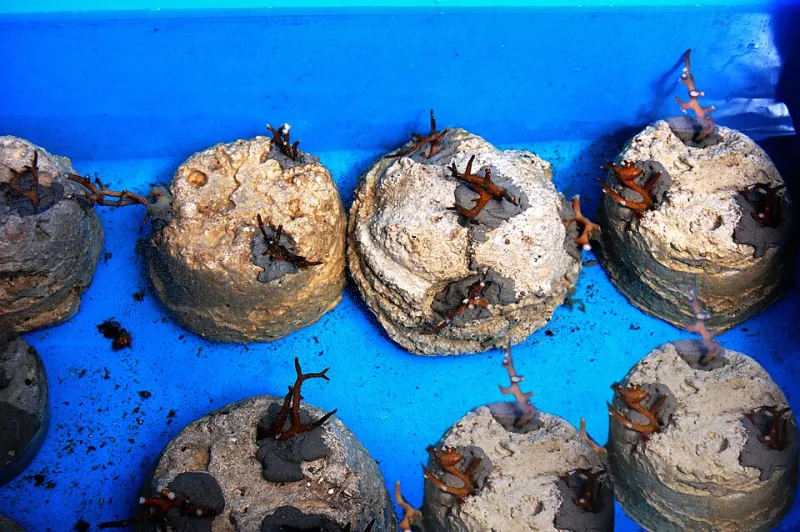
Photo: Profmauri, CC BY-SA 3.0, via Wikimedia Commons
The photographs are compelling. Coral nurseries suspended beneath the surface off the Florida Keys, their branching structures dense with growth, staffed by dedicated researchers and volunteer divers carefully tending each fragment. Outplanting events documented with the visual language of hope—scientists pressing coral colonies onto degraded reef structures, the implication being that what was lost can be rebuilt. These images have become central to how the American public understands coral conservation, and they have been effective at generating funding, media attention, and institutional goodwill.
What they do not always convey is what happens after the cameras leave.
This is not a dismissal of coral restoration science, nor of the researchers and practitioners who have devoted careers to it. It is, rather, an attempt to engage honestly with a body of evidence that the field itself is beginning to confront with greater candor: that the gap between laboratory and nursery performance on one hand, and long-term field survival on the other, is wider than optimistic restoration narratives typically acknowledge—and that closing that gap may require rethinking some foundational assumptions about what restoration can realistically achieve.
The Performance Problem
Coral restoration in the United States is concentrated primarily in two regions: the Florida Reef Tract, the only living barrier reef in the continental US, and the coral ecosystems surrounding Hawaii, which harbor extraordinary levels of endemism. Both systems have experienced severe degradation over recent decades, driven by a convergence of thermal stress events, ocean acidification, disease outbreaks, and chronic local stressors including nutrient runoff and physical damage.
Restoration programs in both regions have produced genuine scientific advances. Coral gardening techniques—fragmenting fast-growing species, cultivating them in mid-water nurseries, then outplanting onto degraded reef structures—have been refined to the point where producing large numbers of corals for outplanting is now operationally feasible. Organizations including the Coral Restoration Foundation in Florida and the Hawaii Institute of Marine Biology have demonstrated that nursery production can be scaled meaningfully.
The harder question, and the one that a growing number of researchers are pressing, concerns what happens to outplanted corals over ecologically meaningful timescales. Published survival data from Florida reef restoration sites presents a complicated picture. Short-term survival rates—measured at six to twelve months post-outplanting—are often reported in the range of 60 to 80 percent for well-managed sites under favorable conditions. But longer-term assessments, particularly those conducted through or after thermal bleaching events, reveal substantially higher mortality. A 2021 analysis examining outplanted Acropora cervicornis colonies across multiple Florida sites found that survival rates collapsed dramatically following the bleaching events of 2014–2015 and again in subsequent thermal stress years, with some sites losing the majority of outplanted material.
Genetics, Adaptation, and the Limits of What We Can Select For
One response to poor thermal tolerance in outplanted corals has been to pursue selective breeding and assisted evolution strategies—identifying genotypes that demonstrate greater heat resistance and prioritizing their propagation. This work is scientifically legitimate and represents one of the more intellectually rigorous threads in contemporary restoration biology. Researchers at the Mote Marine Laboratory in Florida and the Hawaii Institute of Marine Biology have both invested substantially in genomic characterization of coral populations to identify thermally tolerant lineages.
The limitations of this approach, however, deserve careful examination. Thermal tolerance in corals is a complex, polygenic trait influenced by the composition of symbiotic algae (Symbiodiniaceae) within coral tissues, host genetics, and environmental conditioning. Selecting for tolerance to conditions that prevailed during past thermal events does not guarantee tolerance to the conditions corals will face in 2035 or 2050, when ocean temperatures are projected to be measurably higher still.
Dr. Ruth Gates, the late pioneering researcher at the Hawaii Institute of Marine Biology who championed assisted evolution approaches before her death in 2018, was careful to frame these methods as buying time rather than solving the underlying problem. That nuance has not always survived its translation into public-facing restoration advocacy, where the language of "super corals" and genetic innovation sometimes implies a technological solution to what is fundamentally a climate problem.
Ocean Chemistry as the Unquantified Variable
Thermal stress receives the most attention in coral restoration discourse, but ocean acidification may ultimately prove the more intractable constraint. As atmospheric CO₂ concentrations rise, the ocean absorbs a significant fraction of that excess carbon, driving down pH and reducing the concentration of carbonate ions that corals require to build their calcium carbonate skeletons.
Current projections from the Intergovernmental Panel on Climate Change suggest that under moderate emissions scenarios, aragonite saturation states in tropical reef environments will fall below levels considered optimal for coral calcification before mid-century. In Hawaiian waters, where naturally lower saturation states already exist relative to Caribbean reefs, the margin may be narrower still.
Restoration programs have not yet developed robust protocols for selecting or engineering corals with enhanced calcification capacity under low-pH conditions, and some researchers argue that this represents a significant blind spot in the field's current prioritization. Growing a thermally tolerant coral that cannot maintain its skeletal integrity in an acidifying ocean is, at best, a partial solution.
The Resource Allocation Question
Perhaps the most difficult conversation in coral restoration science is not about biology at all—it is about opportunity cost. Restoration programs are expensive. Comprehensive reef restoration in the Florida Keys has been estimated to require hundreds of millions of dollars to achieve meaningful ecological coverage, and even that figure is contested as potentially optimistic given the spatial scale of degradation.
Some ecologists have begun asking, with increasing directness, whether those resources would generate greater conservation returns if redirected toward reducing local stressors—nutrient pollution, sedimentation, coastal development pressure—that compound thermal and acidification stress on reef systems. The evidence that local stress reduction can meaningfully improve reef resilience is reasonably robust. The evidence that outplanting at current scales can reverse trajectory-level reef decline is, to put it charitably, less so.
This is not an argument for abandoning restoration science. Active intervention programs serve important functions beyond their direct ecological outputs: they maintain institutional capacity, generate critical long-term monitoring data, sustain public engagement with reef conservation, and provide experimental platforms for testing adaptation strategies that may become more viable as the science advances. These are not trivial contributions.
But the field would benefit from a more honest public accounting of what restoration can and cannot deliver under plausible near-future ocean conditions. Science communicators, funders, and program advocates have understandable incentives to emphasize success stories and frame progress optimistically. The Marine Forum community understands, however, that durable conservation outcomes depend on accurate diagnosis, not reassuring narrative.
Toward a More Honest Framework
Several researchers working in coral restoration have begun advocating for what might be termed a "managed retreat" framing—acknowledging that some reef areas may not be salvageable under projected climate trajectories and concentrating restoration investment in sites with the greatest biophysical potential for persistence. This involves difficult triage decisions that run counter to the inclusive, everywhere-at-once ethos that has characterized much restoration advocacy.
It also requires the scientific community to communicate uncertainty more clearly than has sometimes been the norm. Survival rates, thermal tolerance limits, and projected ocean chemistry trajectories all carry confidence intervals that matter enormously for program design. Presenting restoration outcomes as more certain than the underlying data support may generate short-term funding enthusiasm, but it ultimately undermines the credibility of the science when field results diverge from projected benchmarks.
Coral restoration deserves continued investment and rigorous scientific attention. The reefs it seeks to protect are among the most biologically significant ecosystems on the planet, and the communities—human and otherwise—that depend on them are real. But the science will serve those communities best when it is pursued and communicated with the same rigor we would demand of any other field confronting a problem of this magnitude.