Bloom and Gloom: Rethinking What Jellyfish Proliferation Actually Tells Us About US Coastal Waters
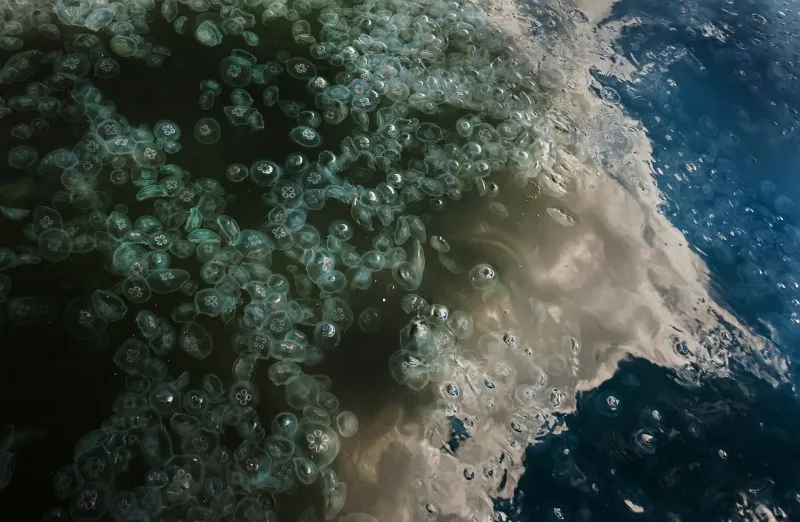
Every summer, beachgoers along the Mid-Atlantic coast encounter them — translucent, pulsing masses washing ashore or drifting just beneath the surface in numbers that can seem almost surreal. Jellyfish blooms have become a fixture of American coastal life, drawing alarm from swimmers, fishers, and environmental reporters alike. But within the scientific community, the meaning of these events is far from settled.
The conversation among marine biologists and oceanographers is not simply about whether jellyfish populations are growing. It is about what that growth signifies — and whether the instinct to classify jellyfish blooms as ecological warnings is, itself, a form of scientific bias worth examining.
A Signal or a Symptom?
The case for viewing jellyfish proliferation as evidence of ecosystem stress is well-documented. Jellyfish thrive under conditions that challenge many other marine species: warmer water temperatures, reduced oxygen levels, elevated nutrient runoff, and depleted fish populations. In the Chesapeake Bay, for instance, sea nettles (Chrysaora quinquecirrha) have long been associated with low-oxygen dead zones driven by agricultural nutrient pollution from surrounding watersheds. Their presence in dense concentrations correlates, in the eyes of many researchers, with the same degraded conditions that suppress commercially important species like striped bass and blue crab.
Dr. Monty Graham, a jellyfish ecologist formerly affiliated with the Dauphin Island Sea Lab in Alabama, has argued publicly that large-scale bloom events should be read as ecosystem distress signals — not because jellyfish are inherently destructive, but because their dominance indicates that the competitive pressures normally keeping their populations in check have been significantly weakened. Remove enough predators, add enough nutrients, and warm the water by even a few degrees, the argument goes, and jellyfish fill the vacuum.
This perspective carries weight in the Gulf of Mexico, where moon jellies and cannonball jellyfish have expanded their seasonal range and density in ways that some researchers link directly to decades of industrial fishing pressure and hypoxic zone expansion.
The Case for a More Measured Reading
Not all marine scientists accept the crisis framing. A growing number of researchers caution against treating jellyfish blooms as unambiguous indicators of decline, pointing out that historical data on jellyfish populations is notoriously sparse and unreliable. Jellyfish are gelatinous, they decompose rapidly, and they were rarely the focus of systematic monitoring efforts before the late twentieth century. This creates what some ecologists call a "shifting baseline" problem: we may be comparing current bloom events against a historical record that was itself incomplete.
Roberto Danovaro and colleagues at the Polytechnic University of Marche — whose work has influenced American researchers studying Pacific Coast blooms — have challenged the assumption that jellyfish are uniformly on the rise globally, arguing that the evidence base is inconsistent across regions and time scales. On the US West Coast, researchers studying moon jelly populations in Puget Sound and along the California coast have found patterns that do not align neatly with a simple proliferation narrative. Some bloom events appear to be cyclical rather than directional, tied to oceanographic oscillations like the Pacific Decadal Oscillation rather than to anthropogenic stressors alone.
For these scientists, the more productive question is not whether jellyfish are "taking over" but whether existing frameworks for assessing ecosystem health are flexible enough to accommodate organisms that have, by evolutionary measure, outlasted nearly every other complex animal on Earth.
Regional Complexity and the Limits of Generalization
One of the recurring challenges in this debate is the difficulty of drawing broad conclusions from what are, in practice, highly localized phenomena. The bloom dynamics observed in the Gulf of Maine differ substantially from those in the Gulf of Mexico or the Southern California Bight. Species composition, seasonal timing, oceanographic drivers, and human pressures vary so considerably across US coastal regions that a unified theory of jellyfish proliferation may be more misleading than clarifying.
In the Northeast, warming sea surface temperatures associated with rapid Gulf of Maine heating have altered the timing and geographic range of several jellyfish species, including the lion's mane (Cyanea capillata), which has been appearing farther south and earlier in the season than historical records suggest. Fishers working out of ports in Maine and Massachusetts have reported fouled gear and reduced catch efficiency during bloom events, raising practical concerns about economic impact alongside ecological ones.
Along the Pacific Coast, by contrast, some researchers have noted that bloom events in certain areas may actually support broader food web functions — providing prey for leatherback sea turtles, ocean sunfish, and some seabird species — complicating any straightforward narrative of ecological harm.
What We Mean When We Say "Healthy"
Perhaps the most philosophically charged dimension of the jellyfish debate is what it reveals about embedded assumptions in marine conservation discourse. The concept of a "healthy" ocean is not value-neutral. It is shaped by historical baselines, by what species humans have chosen to prioritize, and by economic frameworks that tend to weight commercially exploitable fish stocks above other forms of marine life.
Jellyfish, by most conventional metrics, are not commercially valuable in the United States — though they are harvested and consumed extensively in parts of Asia, and some American entrepreneurs have explored processing cannonball jellyfish from the Southeast Atlantic for export. Their ecological contributions, including nutrient cycling, carbon flux through the water column, and as prey items for specialized predators, are only beginning to be quantified in peer-reviewed literature.
If the ocean is shifting toward a state in which jellyfish are more consistently abundant, the critical scientific question is not simply whether that is bad, but whether our current tools and conceptual models are adequate to evaluate it honestly. Some researchers argue that the "jellyfish takeover" framing, however attention-grabbing, forecloses inquiry by presupposing an answer before the data is fully examined.
Moving the Conversation Forward
There is no consensus in sight, and that may be appropriate given the complexity of the subject. What does appear to be gaining traction among marine scientists is a call for more rigorous, long-term monitoring infrastructure — the kind that could finally generate the baseline data necessary to distinguish cyclical variability from directional change. Programs like NOAA's National Centers for Coastal Ocean Science have begun incorporating jellyfish population metrics into broader ecosystem assessments, a development that researchers on both sides of the debate have generally welcomed.
For the public, the jellyfish bloom may remain a summer nuisance or a harbinger of ecological trouble, depending on the headline they encounter. For the scientific community, it represents something more demanding: an invitation to interrogate not just what the ocean is doing, but what assumptions scientists carry with them when they try to decide whether that change is something to mourn or simply to understand.