Microbial Gatekeepers: How Tiny Ocean Organisms May Hold the Key to Climate Tipping Points
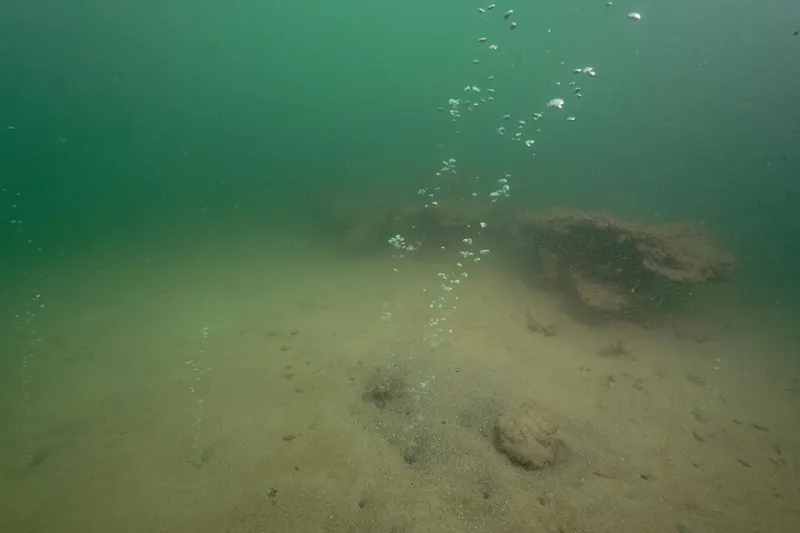
Photo: Olivier Dugornay (IFREMER, Pôle Images, Centre Bretagne - ZI de la Pointe du Diable - CS 10070 - 29280 Plouzané, France), CC BY 4.0, via Wikimedia Commons
The seafloor off the coast of Washington State is not silent. In certain zones, columns of methane gas rise from sediment vents, shimmering upward through the water column in formations that sonar equipment renders as ghostly plumes. These methane seeps have existed for millennia, and for nearly as long, a community of largely invisible organisms has been managing them—consuming methane before it reaches the atmosphere, performing a chemical service whose full value to Earth's climate system science is only beginning to appreciate.
But that balance is under pressure. As ocean temperatures rise and sediment chemistry shifts in response to changing conditions, researchers are confronting a disquieting possibility: the microbial systems that have historically acted as buffers against methane release may be approaching thresholds beyond which their regulatory capacity breaks down. If that happens, the consequences for climate projections—and for the ecosystems that depend on stable ocean chemistry—could be substantial.
The Methane Cycle, Briefly Explained
Methane is a potent greenhouse gas—roughly 80 times more effective than carbon dioxide at trapping heat over a 20-year period. In marine environments, it is produced through a process called methanogenesis, carried out by archaea (single-celled microorganisms distinct from bacteria) in oxygen-depleted sediments. These methanogens break down organic matter in the absence of oxygen, releasing methane as a metabolic byproduct.
Under typical conditions, much of this methane never reaches the atmosphere. It is intercepted by methanotrophic bacteria and archaea—organisms that consume methane as an energy source—in a process known as anaerobic oxidation of methane (AOM). This microbial filtration system operates at the sediment-water interface and, to a lesser extent, throughout the water column, and it is estimated to consume the vast majority of methane produced in marine sediments before it can escape.
The efficiency of this system, however, is not fixed. It is sensitive to temperature, pressure, salinity, and the availability of chemical partners—particularly sulfate, which AOM microbes require to complete their metabolic process. Alter any of these parameters significantly, and the balance between methane production and consumption can shift.
What US Coastal Research Is Revealing
Along the US Pacific margin, a consortium of oceanographers affiliated with institutions including the University of Washington and the Monterey Bay Aquarium Research Institute (MBARI) has been systematically mapping methane seep fields and the microbial communities associated with them. What they are finding complicates earlier, simpler models of how these systems behave.
One particularly significant line of research involves the relationship between bottom water temperature and the stability of gas hydrates—ice-like structures in which methane molecules are trapped within a lattice of water molecules. Gas hydrates are stable only within a specific range of temperature and pressure conditions. As ocean bottom temperatures rise, hydrates in shallower shelf environments begin to dissociate, releasing methane into the sediment column and, potentially, the water above.
Researchers at the University of Washington's School of Oceanography have documented active hydrate dissociation along the Washington and Oregon continental shelves, where bottom water temperatures have increased measurably over the past several decades. The methane released by this dissociation is, in some areas, overwhelming the local capacity of AOM communities to consume it—meaning a greater fraction is reaching the water column than historical models predicted.
On the Atlantic coast, similar dynamics are being observed along the US Mid-Atlantic margin. A 2021 study published in the journal Geophysical Research Letters identified hundreds of previously undocumented methane seeps between Cape Hatteras and Georges Bank, many of them in water depths shallow enough to allow methane to reach the surface mixed layer before being fully oxidized.
The Monitoring Gap
For all the scientific interest these findings have generated, a fundamental problem persists: the infrastructure to monitor these systems at the scale and resolution needed to detect meaningful change simply does not exist.
Current ocean observation networks, including NOAA's National Data Buoy Center and the Integrated Ocean Observing System (IOOS), were not designed with methane flux as a primary measurement target. Dissolved methane sensors capable of continuous, autonomous deployment are available, but they remain expensive, require frequent calibration, and are deployed at only a fraction of the sites where seep activity has been documented.
The result is a significant data gap. Scientists can identify where methane seeps occur and characterize the microbial communities present at individual sites, but translating those point observations into basin-scale flux estimates involves substantial uncertainty. Models of ocean methane release under future warming scenarios carry error bars wide enough to encompass outcomes ranging from manageable to deeply alarming.
Dr. Carolyn Ruppel, who leads the US Geological Survey's Gas Hydrates Project, has been candid about this limitation. In congressional testimony and published research, she has consistently emphasized that the scientific community's ability to forecast methane dynamics under climate change is constrained not by a lack of theoretical understanding, but by a lack of observational data—particularly continuous, long-term records from key seep environments.
Microbes as Early Warning Systems
One emerging perspective within the research community reframes the problem in a potentially useful way: rather than monitoring methane itself as the primary indicator of ecosystem stress, scientists propose monitoring the microbial communities that regulate it. Because AOM communities are sensitive to environmental perturbation, shifts in their composition, abundance, or metabolic activity could serve as leading indicators of broader changes in methane dynamics—detectable before flux rates themselves show a measurable increase.
Advances in environmental genomics have made this approach considerably more tractable than it was even a decade ago. Metagenomic sequencing of sediment and water column samples can now characterize the full complement of microbial taxa present at a site, identify which metabolic pathways are active, and detect community shifts that would be invisible to any other monitoring method. Combined with biogeochemical measurements, this approach offers a far richer picture of ecosystem status than methane concentration data alone.
Research groups at the Woods Hole Oceanographic Institution and the Scripps Institution of Oceanography are among those developing standardized protocols for microbial community monitoring at seep sites, with the goal of establishing baseline datasets against which future change can be measured. The challenge is securing the long-term funding commitments necessary to maintain such programs—a persistent difficulty in a research funding landscape that tends to reward novelty over continuity.
A Question of Scale and Urgency
The scientific questions surrounding marine methane and microbial regulation are, at one level, deeply technical—the province of geochemists, molecular ecologists, and climate modelers. But the implications extend well beyond the laboratory.
If marine methane release is approaching a tipping point—a threshold beyond which positive feedback loops accelerate warming in ways that current climate models do not fully capture—then the window for meaningful intervention may be narrower than policymakers and the public currently appreciate. The microbial systems that have quietly mediated this risk for millennia are telling us something. The question is whether the scientific infrastructure exists to listen carefully enough, and whether the political will exists to act on what it hears.
For the oceanographers and microbiologists working at the intersection of these questions, the stakes could hardly feel more concrete. The ocean is not merely a victim of climate change. It is an active participant—and the organisms driving some of its most consequential processes are ones that cannot be seen without a microscope.