When the Sun Goes Down, the Ocean Rewrites Itself: Inside the Largest Migration on Earth
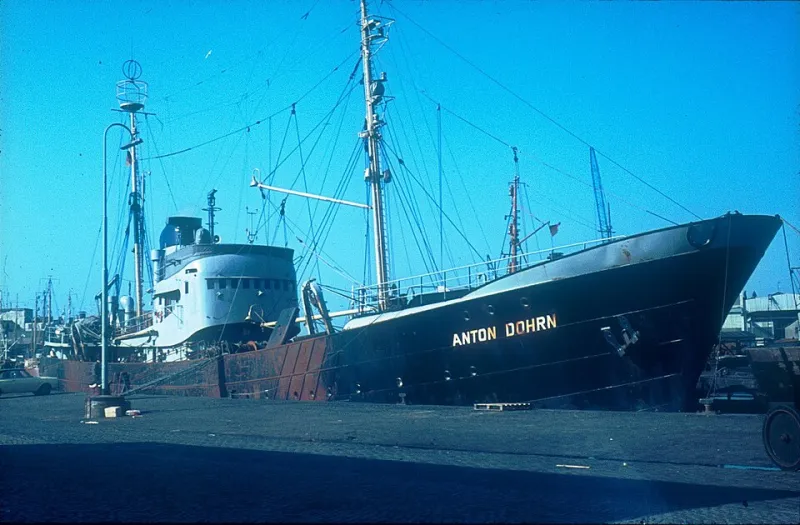
Photo: Manfred Stein, CC BY-SA 3.0 de, via Wikimedia Commons
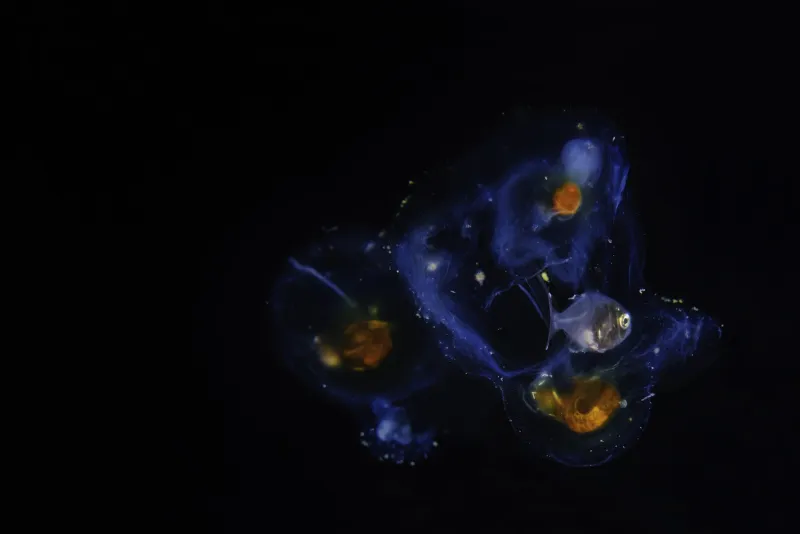
Somewhere off the shelf break of Georges Bank, as the last light leaves the sky, the ocean begins to move. Lanternfish, copepods, krill, siphonophores — organisms measured not in thousands but in billions of tons of biomass — begin a synchronized ascent toward the surface. By midnight, an entire food web has relocated by hundreds of meters. By dawn, it has descended again. This is diel vertical migration, quite possibly the largest coordinated animal movement on the planet, and it happens every single night along every US coastline.
It also happens largely outside the view of the systems we use to manage American fisheries.
A Daytime Bias Built Into the Science
Most fishery-independent surveys — the trawl surveys, hydroacoustic cruises, and plankton tows that feed NOAA stock assessments — run on schedules shaped by logistics as much as by biology. Vessels fish during daylight. Acoustic transects are easier to interpret when the scattering layers are stable. Crews prefer to haul gear in visible conditions. The result is a dataset with a structural blind spot: we sample the ocean primarily during the hours when many of its most important inhabitants have retreated into the deep.
The consequences are not trivial. Species like lanternfish and other mesopelagic forage fish, which shelter at depth by day and feed near the surface at night, may be systematically undercounted. Predators that time their feeding to the nightly ascent — tuna, swordfish, squid, seabirds — are being modeled against a prey landscape that our surveys only see half of. If a stock assessment assumes a static distribution but the prey field moves vertically by 400 meters on a 24-hour clock, the error doesn't average out. It compounds.
What Around-the-Clock Surveys Are Finding
A small but growing number of research teams are running genuinely continuous surveys — 24-hour operations in which acoustic profilers, roving sonar, and net tows cycle through the full diel cycle without pause. Work conducted off California and in the Gulf of Maine has documented vertical migration amplitudes that shift seasonally, compress during warm-water anomalies, and in some years fail entirely during marine heatwaves. When the migration falters, the predators that depend on it scatter or starve.
These studies also reveal something humbling: the deep scattering layer, that acoustic signature familiar to every naval sonar operator since World War II, is not one layer but a shifting stack of communities, each migrating on its own schedule. Some organisms ride a single nightly pulse. Others split their movement across two. A daytime survey doesn't just miss these animals — it misreads the architecture of the ecosystem they structure.
Why the Models Need the Night
The practical argument for round-the-clock monitoring comes down to arithmetic. Catch-per-unit-effort indices, the backbone of many US stock assessments, implicitly assume that catchability is constant. But if fish availability to gear changes with the time of day — and it demonstrably does for species ranging from Pacific hake to Gulf of Mexico reef fish — then survey timing becomes a hidden variable that no one has controlled for.
There are promising fixes. Autonomous profilers and moored echosounders now collect continuous acoustic records at fixed stations for months at a time. Saildrone-type uncrewed surface vehicles can tow instrumentation around the clock without a crew to exhaust. Video-based midwater platforms are beginning to characterize night communities that nets mangle or miss. The technology exists. What lags is institutional habit: assessment frameworks that were designed around daylight surveys, and budget cycles that rarely fund the overnight hours.
Closing the Blind Spot
None of this argues that existing surveys are worthless. They are the foundation of American fisheries science, and their consistency over decades is precisely what makes them valuable. The argument is narrower and more urgent: a monitoring system that cannot see the largest animal migration on Earth is a monitoring system with an unquantified bias, and we should at least know how large that bias is.
A modest start would be straightforward — time-stamped reporting of all survey effort, paired day-night tows on a subset of cruises, and explicit sensitivity analyses in stock assessments that test whether diel timing alters the picture. Off the coasts of Oregon, the Carolinas, and the Gulf, the migration will rise again tonight, as it has for millions of years. The question is whether, this decade, we finally decide to watch it.