Light from the Abyss: How Bioluminescence Is Becoming a Diagnostic Instrument for Deep-Ocean Health
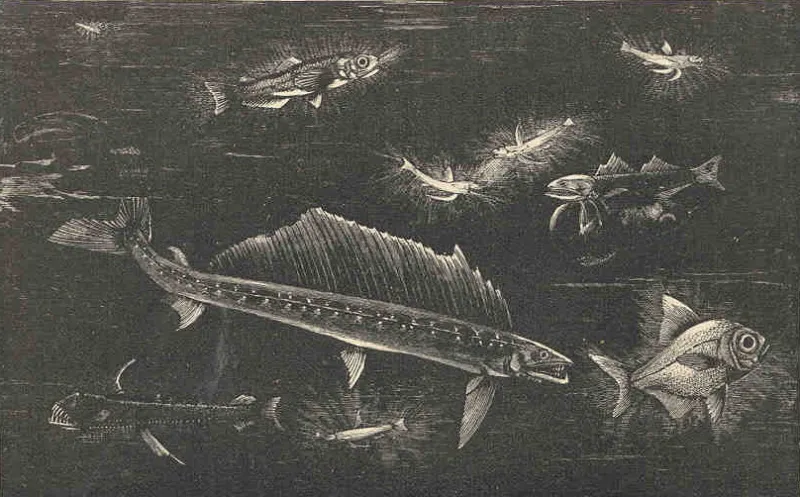
Photo: Holder, Charles Frederick (1892) Along the Florida Reef, New York City, NY: D. Appleton and Company, p. 263, Public domain, via Wikimedia Commons
For most of human history, the deep ocean was imagined as a cold, featureless void. That picture changed dramatically once scientists began descending into it and encountered something unexpected: light. Not sunlight filtered through thousands of meters of water, but living light — produced by organisms ranging from single-celled dinoflagellates to foot-long squid — pulsing, flickering, and streaming through the dark in patterns that no one had anticipated. Today, marine scientists are looking at that biological illumination with new urgency. Rather than treating bioluminescence purely as a subject of wonder, a growing cohort of researchers is deploying it as an instrument — a window into ecosystem processes that conventional sensors struggle to capture.
A Signal Hidden in Plain Darkness
Bioluminescence is, at its core, a chemical reaction. Organisms oxidize a substrate called luciferin in the presence of an enzyme, releasing energy as photons rather than heat. The evolutionary purposes vary widely: some species use light to attract prey, others to confuse predators, and still others appear to communicate or coordinate spawning. What unites these functions is their sensitivity to environmental context. Light production in many species responds to physical disturbance, chemical gradients, temperature shifts, and the presence or absence of specific prey. That responsiveness is precisely what makes bioluminescence scientifically interesting as a monitoring tool.
When a research vessel drags a trawl through a bioluminescent layer, the resulting flash is not random noise. It is, in a meaningful sense, a biological readout — a record of who is present, how dense the population is, and, in some cases, how stressed the community may be. The challenge has always been capturing that signal accurately and at scale.
Technological Inflection Points
For decades, studying deep-sea bioluminescence required direct human observation from submersibles or the crude proxy of net tows. Neither approach yielded the kind of continuous, high-resolution data that ecologists need to track change over time. That is beginning to shift.
The development of highly sensitive, low-noise photomultiplier tubes — instruments capable of detecting individual photons — has made it possible to mount optical sensors on autonomous underwater vehicles and long-duration moorings. Platforms such as Argo-derived profiling floats, now numbering in the thousands across the global ocean, have been adapted by some research groups to carry bioluminescence detectors alongside their standard temperature and salinity sensors. At the Woods Hole Oceanographic Institution in Massachusetts and the Monterey Bay Aquarium Research Institute in California, engineers have refined camera systems capable of recording bioluminescent events in near-total darkness at depth, producing footage detailed enough to identify organisms by their flash characteristics alone.
Perhaps most significantly, machine learning algorithms trained on libraries of bioluminescent signatures are beginning to automate species-level identification from optical data — a task that previously required a specialist reviewing footage frame by frame. The combination of better hardware and smarter software is compressing the gap between data collection and ecological interpretation.
What the Light Is Actually Saying
The ecological applications being developed around bioluminescent monitoring fall into several broad categories, each with distinct implications for how scientists understand deep-ocean systems.
Biomass estimation. In the mesopelagic zone — roughly 200 to 1,000 meters below the surface — vast communities of small fish, crustaceans, and gelatinous organisms perform a daily vertical migration, ascending at night to feed near the surface and descending at dawn. This so-called diel vertical migration is one of the largest animal movements on Earth, and it plays a critical role in transporting carbon from surface waters to depth. Bioluminescent flash rates correlate with organism density in ways that may allow researchers to estimate mesopelagic biomass more reliably than acoustic methods alone, which struggle to distinguish species and size classes.
Hypoxia detection. Oxygen minimum zones — regions of the ocean where dissolved oxygen drops to levels that most metazoans cannot tolerate — are expanding in several ocean basins, a trend linked to warming and altered circulation. Some bioluminescent species are sensitive indicators of oxygen conditions, either disappearing from hypoxic layers or altering their flash behavior in response to physiological stress. Monitoring bioluminescent activity in these zones may provide early warning of boundary shifts that standard oxygen sensors detect only after the fact.
Pollution and contamination proxies. Certain dinoflagellate species that produce bioluminescence are also among the most responsive biological indicators of chemical contamination. Shifts in their abundance or light output have been proposed as cost-effective screening tools in coastal and offshore environments, though this application remains at an earlier stage of validation.
The Unexplored Majority
One of the most striking facts about deep-sea bioluminescence is how little of it has been systematically documented. Estimates suggest that more than 75 percent of deep-sea organisms are capable of producing light, yet baseline data on bioluminescent activity across most of the ocean's volume simply does not exist. This is not merely an academic gap. Without baselines, detecting change is nearly impossible.
The National Oceanic and Atmospheric Administration's Ocean Exploration program has in recent years incorporated bioluminescence documentation into some of its deep-sea expedition protocols, and several university-led projects have begun establishing long-term optical monitoring stations at fixed deep-sea sites off the US West Coast and in the Gulf of Mexico. These efforts are nascent, but they represent a meaningful shift in how the scientific community conceptualizes bioluminescence — less as a spectacle and more as a data stream.
Challenges That Remain
The field faces real methodological hurdles. Bioluminescent signals are inherently variable: a single organism may flash thousands of times per minute when disturbed, or not at all when quiescent. Separating ecologically meaningful patterns from instrument-induced artifact requires careful experimental design and, in many cases, simultaneous biological sampling to ground-truth optical readings. Standardization across research groups and platforms remains a work in progress, complicating efforts to compare data collected by different institutions.
There is also the question of depth and pressure. Optical sensors designed for shallow-water work do not always perform reliably at abyssal depths, and the engineering costs of building and maintaining instruments rated for full-ocean depth are substantial. Funding cycles in US oceanography have not always aligned well with the long-term deployment strategies that bioluminescent monitoring requires.
A Frontier Worth Illuminating
Despite these challenges, the scientific case for investing in bioluminescent monitoring is compelling. The deep ocean regulates climate, supports global fisheries, and harbors biodiversity that humanity has barely catalogued. Understanding how it is changing — and how quickly — demands tools that can operate continuously in environments where conventional observation is prohibitively expensive. Bioluminescence, produced freely and abundantly by the ocean's own inhabitants, offers exactly that kind of persistent, distributed signal.
The organisms living in darkness have been generating light for hundreds of millions of years. Marine science is only now developing the instruments and analytical frameworks to listen to what that light is saying.