Rise of the Eight-Armed Opportunists: What Cephalopod Dominance Tells Us About Shifting Ocean Food Webs
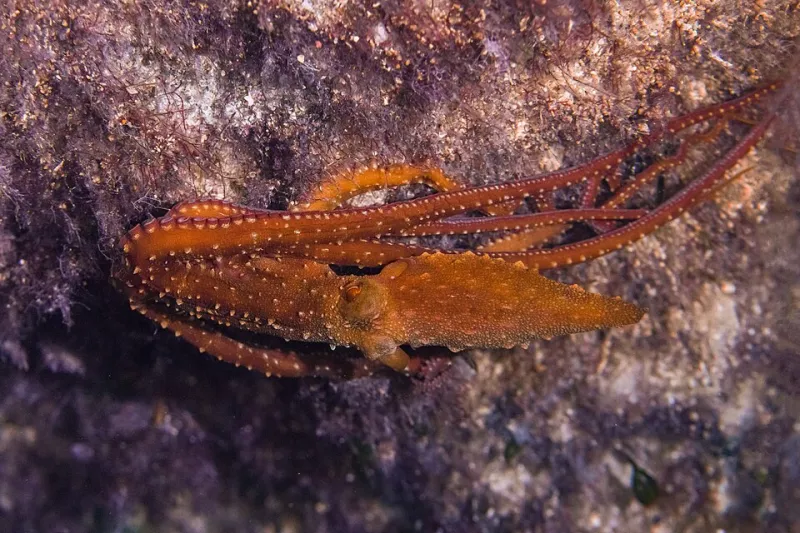
Photo: Diego Delso, CC BY-SA 4.0, via Wikimedia Commons
For decades, marine ecologists have tracked the slow erosion of large predatory fish populations across American coastal waters. Overfishing, habitat degradation, and warming seas have taken a measurable toll on species from Atlantic cod to Pacific rockfish. Yet while these traditional pillars of ocean food webs have faltered, another group of predators has moved, with quiet efficiency, into the spaces left behind. Octopuses, squid, and their cuttlefish relatives — collectively the cephalopods — are thriving. The question marine biologists are now wrestling with is not simply why, but what this shift portends for ocean ecosystems as a whole.
An Unlikely Winner in a Stressed Ocean
Cephalopod population data from both coasts tells a striking story. Landings of Humboldt squid off the Pacific coast have fluctuated dramatically but trended upward over multi-decade timescales, while market squid harvests in California consistently represent one of the state's highest-volume fisheries by weight. On the Atlantic side, longfin inshore squid have become an increasingly dominant feature of mid-Atlantic trawl surveys. These are not marginal observations — they represent a statistically significant pattern that researchers have been tracking with growing attention.
Dr. William Gilly, a neurobiologist at Stanford's Hopkins Marine Station who has spent years studying Humboldt squid behavior, has described these animals as extraordinarily adaptable to environmental disruption. Unlike many fish species that require specific thermal conditions and stable prey fields to reproduce successfully, cephalopods appear to capitalize on precisely the kind of ecological instability that undermines their competitors.
The Biology of Resilience
Understanding why cephalopods are succeeding where others are struggling requires a closer look at their life history — and it is genuinely unusual. Most cephalopod species live for only one to two years. They grow at extraordinary rates, converting prey biomass into body mass with an efficiency that few marine animals can match. They reproduce in large, single-event spawning episodes and then die, meaning their populations can respond to favorable conditions within a single season rather than across years or decades.
This rapid generational turnover is, paradoxically, one of their greatest evolutionary advantages in a changing ocean. Where a long-lived species like Atlantic bluefin tuna requires years to reach reproductive maturity — leaving populations vulnerable to prolonged periods of poor recruitment — a common market squid can complete its entire life cycle in under a year. When conditions improve, even briefly, cephalopod populations can rebound with a speed that slower-reproducing species simply cannot match.
There is also the matter of dietary flexibility. Cephalopods are opportunistic predators capable of switching prey items as availability changes. Studies tracking the stomach contents of Pacific octopuses along the Oregon and Washington coasts have documented prey lists that range from crabs and clams to small fish and even other cephalopods. This generalism insulates them from the collapse of any single prey population — a resilience that is increasingly valuable as climate-driven shifts reshuffle species distributions across US waters.
Filling the Predator Vacuum
The ecological consequences of cephalopod proliferation are not straightforward. In a healthy, structurally intact food web, large predatory fish serve as regulators — keeping prey populations in check and maintaining the cascading balance of energy flow from plankton upward. When those predators are removed or diminished, the system does not simply pause; it reorganizes. Cephalopods, in many documented cases, appear to be among the primary beneficiaries of that reorganization.
Researchers at the Northeast Fisheries Science Center have noted that squid, in particular, now occupy a more prominent role in the diet of remaining large predators — swordfish, tuna, and marine mammals — than historical baselines would suggest. This is partly a story of cephalopods becoming more abundant, but it is also a story of those predators having fewer alternatives. The food web is not simply accommodating cephalopods; in some regions, it is being restructured around them.
This restructuring carries implications that extend well beyond scientific interest. Fishing communities from New England to the Pacific Northwest have watched the composition of their catches shift over the course of careers. Boats that once targeted groundfish now find squid filling their holds. While some ports have adapted — New Bedford, Massachusetts, for instance, has developed processing infrastructure for squid alongside its traditional groundfish operations — others lack the capital equipment and market connections to pivot effectively.
Intelligence as an Ecological Variable
One dimension of this story that rarely enters fisheries management discussions is the cognitive sophistication of cephalopods. Octopuses in particular have demonstrated problem-solving abilities, spatial memory, and behavioral flexibility that are exceptional among invertebrates. Whether these cognitive traits confer direct ecological advantages — enabling more efficient hunting strategies, better predator avoidance, or more effective use of novel habitat — remains an active area of research.
What is clearer is that behavioral flexibility, whatever its neural basis, likely contributes to the ability of octopuses and their relatives to exploit new ecological niches as they open. Anecdotal reports from fishers along the Gulf of Mexico have described octopuses colonizing artificial reef structures and derelict gear at rates that surprised local researchers. Whether this represents genuine range expansion or simply improved detection is an open methodological question, but it aligns with broader trend data pointing toward increased cephalopod presence across disturbed habitats.
What the Data Cannot Yet Tell Us
For all the evidence pointing toward cephalopod proliferation, significant uncertainties remain. Cephalopod population assessments are notoriously difficult. Their short life spans mean that annual surveys can capture very different demographic snapshots depending on timing. Their patchy distributions make trawl-based abundance estimates unreliable in ways that differ from assessments of more sedentary species. And historical baseline data is often sparse, making it genuinely difficult to distinguish a recent trend from natural variability.
Some researchers caution against interpreting current abundance as a permanent new equilibrium. Cephalopod populations have historically shown boom-and-bust dynamics — the same rapid reproduction that drives their surges can leave them equally vulnerable to crashes when environmental conditions shift unfavorably. What appears to be a stable rise may, on longer timescales, prove to be the peak of a cycle.
A Forum for Difficult Questions
The cephalopod story is, at its core, a story about what happens to ocean ecosystems under sustained pressure — and about the difficulty of distinguishing winners from survivors. For the marine science community, it raises methodological questions about how we assess abundance and ecological function in fast-moving, flexible species. For fisheries managers, it raises policy questions about whether management frameworks designed around long-lived fish species are equipped to handle rapidly shifting community compositions. And for fishing communities, it raises practical questions about adaptation, investment, and the future shape of American seafood markets.
None of these questions have clean answers. But the octopuses, at least, do not appear to be waiting for us to work them out.