The Middle Tier Matters: How Losing Groupers, Snappers, and Jacks Is Quietly Unraveling US Fishery Food Webs
A Blind Spot in Fisheries Science
For decades, conservation discourse around marine predators has centered on the most charismatic: great white sharks patrolling the Pacific, sperm whales navigating the deep Atlantic, orca pods threading through Pacific Northwest waters. The scientific literature on apex megafauna is substantial, and public attention reliably follows. Yet a growing body of research suggests that this focus, however warranted, has left a critical gap in our understanding of how US coastal fisheries actually function.
The fish occupying the middle tiers of marine food webs—species such as red grouper, yellowtail snapper, greater amberjack, and crevalle jack—are neither as charismatic as sharks nor as commercially dominant as cod or tuna in the public imagination. But in terms of their structural role within coastal ecosystems, they may be indispensable. Their removal, often gradual and commercially rationalized, is producing consequences that fisheries managers are only beginning to fully document.
Defining the Middle-Tier Predator
The term "mid-level predatory fish" can obscure more than it clarifies unless carefully defined. In the context of US coastal systems, these are species that sit above forage fish and invertebrates in the food web but below the largest pelagic predators. They are typically reef-associated or structure-dependent, often slow to mature, and highly site-faithful—meaning they do not readily redistribute across wide geographic ranges when local populations are depleted.
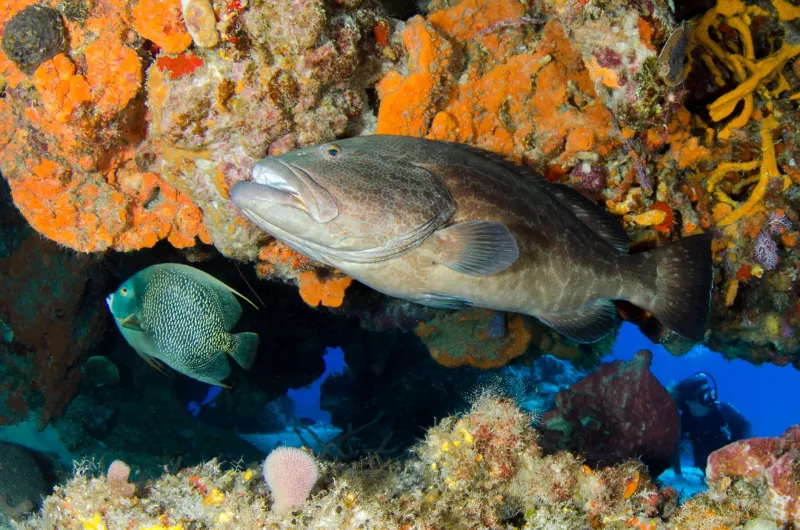
Groupers in the Gulf of Mexico and South Atlantic, for instance, are ambush predators that exert significant top-down pressure on reef fish assemblages, crustaceans, and cephalopods. Snappers fulfill overlapping roles but with somewhat broader habitat use. Large jacks, including greater amberjack and almaco jack, are more mobile and act as pursuit predators across both reef and pelagic zones. Together, these species function as what ecologists sometimes call "mesopredators"—a term borrowed from terrestrial ecology that captures their dual role as both predator and prey within the broader food web architecture.
When the Middle Disappears
The removal of mesopredatory fish does not produce a simple linear response. Instead, it initiates a cascade of compensatory and destabilizing shifts that can propagate both upward and downward through the food web simultaneously.
Research conducted in the Florida Keys and the broader Gulf of Mexico has documented what happens when grouper populations are substantially reduced through fishing pressure. In the absence of sufficient grouper biomass, populations of smaller reef fish—particularly grunts, squirrelfish, and certain wrasse species—can expand rapidly. These smaller species compete aggressively with the juvenile stages of commercially valuable fish, including snapper recruits, for both food and shelter space on the reef. The result is a recruitment bottleneck: even when spawning stock biomass appears adequate on paper, juvenile survival rates decline because the structural conditions that once supported recruitment have been altered.
This phenomenon—sometimes described informally as "competitive release from below"—is distinct from the better-documented predator-prey dynamics that dominate most fisheries modeling. It operates through indirect pathways, making it difficult to detect without long-term, multi-species monitoring data.
The Snapper-Grouper Complex as a Case Study
The South Atlantic Fishery Management Council's snapper-grouper complex represents one of the most intensively managed multi-species assemblages in US federal waters. It encompasses more than 70 species and supports substantial commercial and recreational fishing industries from North Carolina through the Florida Keys. It also provides an instructive case study in the challenges of managing middle-tier predators as an ecological unit rather than as individual stock targets.
For much of the late twentieth century, management frameworks for this complex were organized around single-species stock assessments. Red snapper, vermilion snapper, and various grouper species were evaluated largely in isolation, with annual catch limits set according to estimated maximum sustainable yield for each species independently. The ecological interactions between these species—competition for prey, habitat overlap, ontogenetic diet shifts—received comparatively little formal attention in the regulatory process.
Scientists affiliated with NOAA's Southeast Fisheries Science Center have increasingly argued that this approach is insufficient. When grouper populations are suppressed, snapper populations do not simply fill the ecological void; the altered competitive landscape and prey availability can produce unpredictable shifts in snapper growth rates, condition factors, and spatial distribution. Managing one species without accounting for its functional relationships with others introduces systematic blind spots into the assessment process.
Jacks, Currents, and the Pelagic Dimension
Large jacks introduce an additional layer of complexity because of their mobility. Unlike reef-resident groupers, species such as greater amberjack range across considerable distances and connect reef, nearshore, and open-water habitats in ways that are not easily captured by standard demersal survey methods.
When amberjack populations decline—as they did substantially in the Gulf of Mexico during the 1990s and early 2000s—their role as mid-water pursuit predators is partially vacated. This creates what some researchers describe as a "predation gap" in the water column above reef structures, which can be exploited by fast-reproducing, opportunistic species with few natural controls. Invasive lionfish, now established throughout the Gulf and Caribbean, have proven particularly adept at occupying this niche, and their proliferation has been linked in part to the reduced predation pressure that accompanies depleted jack and grouper populations.
The lionfish connection is significant not merely as an ecological footnote but as a practical management concern. Lionfish removal programs, however well-organized, cannot substitute for the restoration of native mesopredator communities that would otherwise regulate invasive fish populations through natural predation and competitive exclusion.
Implications for Fisheries Management
The scientific case for incorporating mesopredator dynamics into formal fisheries management frameworks is strengthening, but the practical path forward remains contested. Ecosystem-based fisheries management, long endorsed in principle by NOAA and the regional fishery management councils, has proven difficult to implement at the operational level. Multi-species models require data inputs that are expensive to collect and often uncertain in their parameters. Stakeholder communities—commercial fishers, charter boat operators, recreational anglers—each hold different priorities, and consensus around reduced harvest targets for multiple species simultaneously is difficult to achieve politically.
Nevertheless, several research groups are developing approaches that may help bridge the gap between ecological theory and regulatory practice. Functional group modeling, which aggregates species by their trophic role rather than treating each taxon individually, offers a computationally tractable way to capture mesopredator dynamics without requiring complete species-by-species parameterization. Pilot applications in the Gulf of Mexico have produced results that diverge meaningfully from single-species assessments, suggesting that current management may be systematically underestimating ecosystem-level fishing impacts.
The Broader Conversation
What the science of middle-tier predators ultimately demands is a recalibration of how we define fisheries health. A system that retains adequate biomass of target species while losing the functional predator structure that governs recruitment, competition, and invasive species regulation is not, in any ecologically meaningful sense, a healthy system. It is a system that may appear productive in the short term while quietly accumulating the conditions for longer-term instability.
For marine biologists, fisheries managers, and conservation advocates engaged with US coastal systems, the challenge is to make this slower, less visible form of ecosystem degradation legible—to translate complex trophic dynamics into terms that can inform policy, guide harvest decisions, and sustain the fishing communities that depend on these waters remaining productive. The middle tier of the food web has long been easy to overlook. The evidence suggests we can no longer afford that oversight.