Sound Science: How Hydrophone Networks Are Giving Marine Conservationists a New Ear on US Coastal Waters
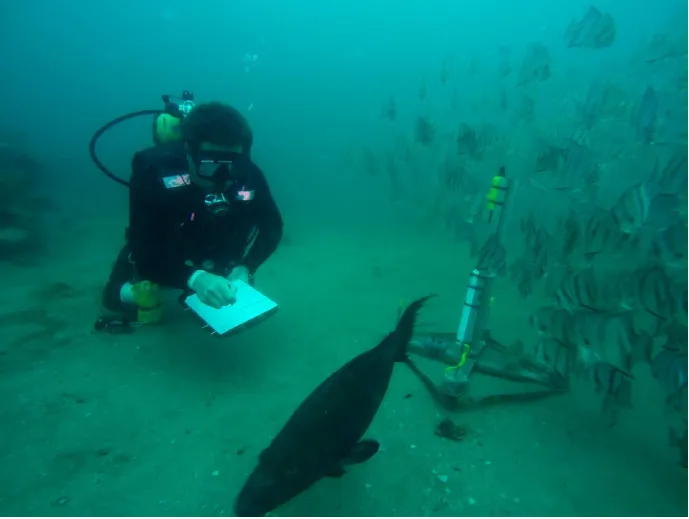
Photo: Anonymous National Oceanic and Atmospheric Administration photographer, Public domain, via Wikimedia Commons
The ocean has never been silent. Long before the first research vessel lowered a microphone into the sea, marine life was communicating, navigating, and sensing the world through sound. Water transmits acoustic energy far more efficiently than air, and the creatures that evolved in it have exploited that property in extraordinary ways — from the low-frequency moans of blue whales traveling thousands of miles to the rhythmic clicking of snapping shrimp colonies that can register on instruments across an entire bay.
For most of marine science's history, that acoustic dimension was largely inaccessible. Visual surveys, trawl sampling, and satellite imagery dominated the methodological toolkit. Today, a growing community of oceanographers, conservation biologists, and community scientists is deploying underwater listening arrays along US coastlines that are fundamentally changing what we can know about ocean health — and how quickly we can know it.
The Case for Listening
Conventional marine biodiversity surveys are labor-intensive, spatially limited, and often disruptive to the organisms being studied. A trawl net captures a snapshot of what was present at one location on one day, and the act of sampling can itself alter animal behavior in the vicinity. Visual transect surveys conducted by divers or remotely operated vehicles share similar constraints.
Passive acoustic monitoring operates on an entirely different logic. A properly positioned hydrophone records continuously, capturing behavioral and ecological information around the clock without active disturbance. Over time, those recordings accumulate into longitudinal datasets that can reveal seasonal migration patterns, spawning aggregations, population trends, and responses to environmental disturbances in ways that episodic surveys cannot.
"The ocean is incredibly loud if you know how to listen," said a marine bioacoustician at a New England research institution who has spent her career developing acoustic indices for ecosystem assessment. "Every species that produces sound is essentially broadcasting its presence. We're finally reaching a point where we can decode enough of that signal to make it useful for conservation management."
From the Gulf of Maine to the California Current
Along the northeastern US coast, acoustic monitoring has become an indispensable tool in the effort to protect the critically endangered North Atlantic right whale. With a population estimated at fewer than 360 individuals, the species cannot afford the detection gaps that traditional visual surveys leave during periods of poor weather, darkness, or rough seas.
The Woods Hole Oceanographic Institution and several partner organizations have deployed a network of autonomous underwater listening systems — some moored, others integrated into ocean gliders — across critical right whale habitat in the Gulf of Maine and adjacent waters. These systems detect the distinctive up-calls produced by right whales and transmit alerts in near-real time, enabling dynamic management measures such as vessel speed restrictions in areas where whales have been acoustically confirmed.
The practical results have been meaningful. When acoustic detections are incorporated into shipping lane management, the probability of a vessel encountering a right whale without warning decreases substantially compared to schedules based on seasonal predictions alone. For a species where ship strikes represent one of the two leading causes of human-caused mortality, that margin matters enormously.
On the opposite coast, researchers working within the California Current Ecosystem — one of the most productive marine systems in the Northern Hemisphere — are applying acoustic monitoring to a different set of conservation challenges. NOAA's Pacific Marine Environmental Laboratory and affiliated university partners maintain hydrophone arrays that track the movements of blue, fin, and humpback whales along the migratory corridors used by animals traveling between their feeding grounds off California, Oregon, and Washington and their breeding areas farther south.
Those same arrays capture acoustic signatures relevant to fisheries management. Several commercially important fish species, including Pacific hake and various rockfish, produce sounds during spawning that experienced analysts can distinguish from background noise. Detecting those spawning choruses provides information about reproductive timing and habitat use that is difficult to obtain through any other means at comparable spatial and temporal scales.
Community Scientists Enter the Acoustic Space
One of the more consequential developments in marine acoustic monitoring over the past decade has been the democratization of the technology. Hydrophone costs have dropped substantially, and open-source software platforms for acoustic analysis have made it possible for organizations well outside the traditional research university pipeline to contribute meaningful data.
In the Pacific Northwest, tribal nations with treaty-protected fishing rights have begun deploying their own listening arrays in nearshore waters as part of broader efforts to exercise co-management authority over salmon and marine mammal populations. The acoustic data these communities collect feeds into shared databases that inform decisions affecting both tribal and commercial fisheries.
Along the Gulf Coast, conservation organizations working with limited budgets have partnered with recreational divers and boating clubs to deploy low-cost hydrophone units at reef sites and in estuarine habitats. The resulting datasets, while not always comparable in technical precision to research-grade recordings, have identified fish spawning events at locations and times that were previously undocumented in the scientific literature.
"There's something genuinely exciting about what happens when you put a listening tool in the hands of someone who's been diving the same reef for 20 years," observed a marine ecologist who coordinates a community acoustic monitoring program along the Florida Panhandle. "They know that reef in ways that visiting researchers don't. Combining that local knowledge with acoustic data produces insights neither party would reach alone."
The Limits of Sound
Enthusiasm for acoustic monitoring is warranted, but the technology is not without significant constraints that researchers are candid about acknowledging.
Acoustic identification of species relies on the existence of well-characterized sound libraries — catalogues of known vocalizations against which new recordings can be compared. For charismatic megafauna like large whales and dolphins, those libraries are reasonably well developed. For many fish species and invertebrates, they remain incomplete or entirely absent. An unusual sound in a recording may indicate the presence of an unstudied species, an undocumented behavior, or simply noise from an anthropogenic source that resembles biological activity.
Anthropogenic noise itself poses a compounding problem. Shipping traffic, sonar operations, offshore energy development, and recreational boating all inject acoustic energy into the marine environment that can mask biological signals, alter animal behavior, and complicate data interpretation. Researchers studying acoustic ecology must simultaneously account for the organisms they are trying to monitor and the noise landscape within which those organisms are operating.
Data volume presents a further challenge. A single hydrophone recording continuously generates enormous quantities of audio data. Analyzing that data manually is impractical at scale, and while machine learning algorithms have made automated species detection substantially more accurate in recent years, they introduce their own sources of error that must be carefully characterized before outputs are used in high-stakes management decisions.
Building the Case for Policy
Despite these limitations, the trajectory of bioacoustic monitoring as a conservation tool is clearly upward. NOAA has expanded its investment in passive acoustic research networks, and several recent federal marine spatial planning processes have incorporated acoustic data as a formal input alongside traditional survey information.
For the scientists and community practitioners who have spent years arguing that listening to the ocean offers a qualitatively different and complementary window on ecosystem health, that institutional recognition represents progress. The question now is whether the data pipelines, analytical standards, and interagency coordination mechanisms necessary to translate acoustic information into durable conservation policy can keep pace with the technology's expanding reach.
"We've gotten very good at collecting sound," said the New England bioacoustician. "The next challenge is making sure the people who make decisions about the ocean know how to use what we're hearing."