Unwelcome Arrivals: The Battle to Contain Non-Native Species Along America's Coastlines
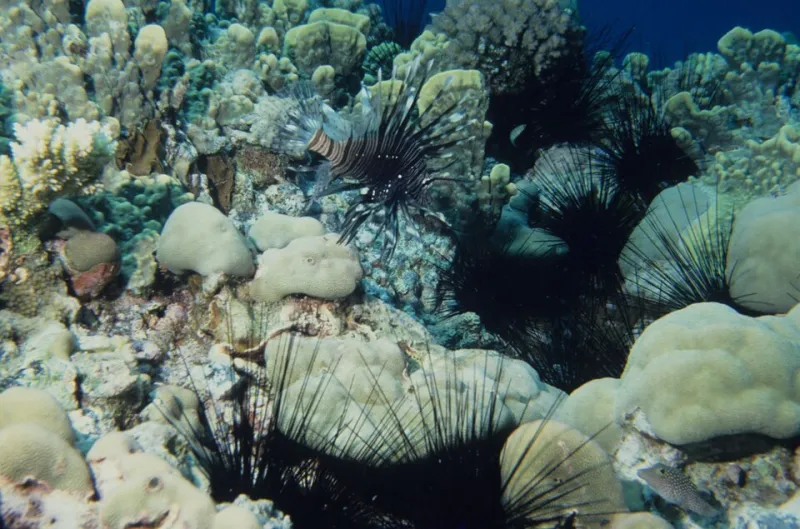
Photo: Derek Keats from Johannesburg, South Africa, CC BY 2.0, via Wikimedia Commons
When the red lionfish (Pterois volitans) first appeared in Atlantic waters off Florida in the mid-1980s, marine biologists treated the sighting as a curiosity. By the 2000s, it had become a crisis. Today, lionfish are documented from the coast of North Carolina down through the Caribbean and into the Gulf of Mexico, their venomous spines and voracious appetites reshaping reef communities that evolved without any defenses against them. The lionfish story is, unfortunately, not unique. It is a template—one being repeated with troubling regularity along virtually every stretch of American coastline.
Invasive marine species represent one of the most consequential and least visible threats to ocean ecosystems in the United States. Unlike an oil spill or a dead zone, a biological invasion rarely announces itself with a dramatic visual. It accumulates quietly, organism by organism, until the ecological arithmetic of a habitat has been fundamentally rewritten.
The Scale of the Problem
The National Oceanic and Atmospheric Administration (NOAA) currently tracks more than 500 established non-native species in US marine and estuarine waters. The vectors through which these organisms arrive are numerous: ballast water discharged by commercial vessels, hull fouling on recreational and commercial boats, the aquaculture trade, live seafood markets, and even the release of aquarium pets by well-meaning but uninformed hobbyists.
On the Atlantic and Gulf coasts, lionfish remain the most high-profile example. Research conducted by the Florida Fish and Wildlife Conservation Commission has demonstrated that a single lionfish can reduce juvenile fish recruitment on a reef section by as much as 79 percent within five weeks of arrival. Their impact on economically important species—snapper, grouper, and the small forage fish that sustain them—reverberates far beyond the reef itself.
The Pacific coast presents a different but equally serious roster of concerns. The Asian shore crab (Hemigrapsus sanguineus), now firmly established along the northeastern seaboard, competes aggressively with native species for food and shelter. Meanwhile, the European green crab (Carcinus maenas) has extended its range northward into Pacific Northwest estuaries, where it devastates eelgrass beds and native shellfish populations—habitats that Indigenous communities and commercial fisheries alike depend upon.
Why Early Detection Keeps Failing
The fundamental challenge of marine biosecurity is one of scale and medium. Water obscures. Tidal systems are vast, often remote, and in constant flux. Many invasive species spend critical early phases of their life cycle as microscopic larvae, indistinguishable to the naked eye from native counterparts. By the time a population becomes large enough to observe through conventional survey methods, eradication is typically no longer a realistic option.
Dr. Whitman Miller, a researcher at the Smithsonian Environmental Research Center in Edgewater, Maryland, has described the current surveillance infrastructure as fundamentally reactive. "We are almost always responding to invasions that are already well underway," he noted in a 2022 symposium on marine biosecurity. "Our monitoring networks were not designed for early interception. They were designed for documentation."
Funding constraints compound the problem. State-level marine invasive species programs are chronically underfunded relative to the scope of coastline they are asked to monitor. Federal programs administered through NOAA and the US Fish and Wildlife Service provide important baseline support, but gaps in coordination between agencies—and between federal and state authorities—allow invasions to slip through jurisdictional seams.
The Ecological Cascade
Understanding why invasive species are so ecologically disruptive requires moving beyond individual species impacts and examining the cascade effects they trigger. When an apex predator like the lionfish is introduced into a reef ecosystem, it does not merely reduce fish populations. It alters prey behavior, changes the competitive dynamics among surviving species, and can shift the entire community composition of a habitat over time.
Similarly, the European green crab's destruction of eelgrass beds in Pacific Northwest estuaries removes critical nursery habitat for juvenile salmon—a species already under severe pressure from habitat loss, warming ocean temperatures, and altered river hydrology. The loss of a single invasive species' target habitat can thus propagate stress across multiple trophic levels and into adjacent ecosystems.
Marine ecologists use the term "invasional meltdown" to describe scenarios in which multiple invasive species interact in ways that amplify each other's impact. Researchers studying San Francisco Bay—one of the most heavily invaded estuaries in the world—have documented precisely this phenomenon, where introduced species now dominate the system to such a degree that restoring pre-invasion community structure is considered effectively impossible.
Emerging Tools and the Case for Proactive Biosecurity
The picture is not without cause for measured optimism. Environmental DNA (eDNA) technology has emerged as one of the most promising tools in early detection. By sampling water for trace genetic material shed by organisms, scientists can identify the presence of a target species before population densities are high enough to detect through visual surveys. NOAA's Great Lakes Environmental Research Laboratory has deployed eDNA monitoring with considerable success in freshwater systems, and researchers are actively adapting these protocols for high-salinity coastal environments.
Autonomous underwater vehicles (AUVs) equipped with imaging systems and AI-assisted species identification software represent another frontier. Pilot programs in the Florida Keys and along the California coast have demonstrated that sustained, wide-area monitoring—previously impractical due to cost and personnel limitations—becomes considerably more feasible when human observers are replaced by autonomous platforms.
Yet technology alone will not resolve a problem that is, at its core, as much institutional as it is scientific. Researchers and conservation advocates across the field consistently return to the same conclusion: the United States needs a national marine biosecurity framework with genuine teeth—one that mandates rigorous ballast water treatment standards, enforces hull inspection and cleaning requirements, and invests in the kind of coordinated, real-time surveillance infrastructure that countries like New Zealand and Australia have built over the past two decades.
A Shift in Philosophy
Perhaps the most important conceptual shift being urged by the marine science community is a move away from thinking about invasive species management as a series of discrete crises to be addressed individually, and toward treating biosecurity as a continuous, system-wide responsibility.
This means investing in prevention at the point of entry—ports, marinas, and aquaculture facilities—rather than waiting for populations to establish and then attempting the near-impossible task of suppression. It means building public awareness campaigns that reach recreational boaters, anglers, and aquarium hobbyists, who collectively represent significant introduction pathways that receive far less regulatory scrutiny than commercial shipping.
And it means, above all, accepting that the ecological communities along America's coastlines are not static. They are being actively reshaped—by climate change, by pollution, and by the steady arrival of species that did not evolve within them. How aggressively the United States chooses to defend those communities will say a great deal about the seriousness with which it treats ocean conservation as a national priority.